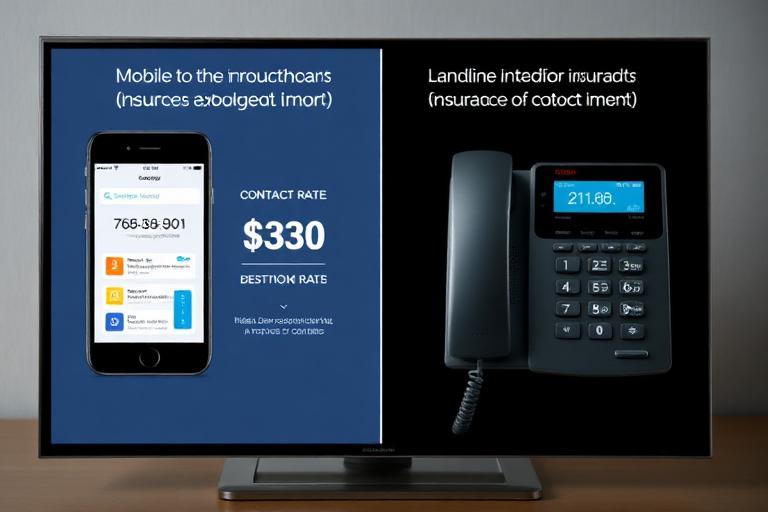
Two agents. Same script. Same dialer. One has a 12% contact rate. The other has a 4% contact rate. The only meaningful difference: one is dialing mobile numbers, the other is dialing landlines. That gap — 12% vs. 4% — represents 8 extra conversations per 100 dials. At a typical insurance close rate of 15%, that's 1.2 additional closed policies per 100 dials. Just from the list type.
The Contact Rate Gap Is Real — Here's the Data
According to the National Center for Health Statistics' 2024 Wireless Substitution report, 57.8% of American adults now live in wireless-only households — meaning they have no landline at all.[1] Among adults aged 25–34, the figure exceeds 72%. Among adults aged 65–74 (Medicare's core demographic), the wireless-only rate is over 40% and rising every year.
If you're buying landline-heavy data, you're dialing a minority of the addressable population — and a rapidly shrinking one.
Why Mobile Numbers Answer More Often
- Caller ID recognition: Cell phone users are more likely to see your call and make a decision to answer.
- Number portability habit: People keep their cell numbers when they move. A mobile number may have been the same for 15+ years.
- SMS follow-up possibility: Mobile numbers allow compliant text follow-up as part of a multi-touch nurture sequence.
- Lower list redundancy: Mobile numbers are more uniquely tied to one individual.
The TCPA Difference: This Is Where It Gets Important
Higher contact rates come with a compliance obligation. Mobile numbers are protected by TCPA in a way that landlines are not.
- Calling a landline with an autodialer: requires DNC compliance, calling hour compliance, and TCPA disclosures — but does not require prior express written consent under the ATDS prohibition.[2]
- Calling a mobile number with an autodialer: requires all of the above plus prior express written consent. Each call without documented consent is a separate TCPA violation at $500–$1,500.
This is not a reason to avoid mobile leads — it's a reason to buy mobile leads that come with consent documentation.
The Ported Number Problem
Number portability means you cannot tell from an area code whether a number is currently mobile or landline. A (212) New York number may be on a Verizon cell phone. "I thought it was a landline" is not a recognized defense.
Real-time line type lookup — also called number type verification — checks the current carrier assignment for each number. It's part of the standard verification process at Sky Net's pricing.
What to Look for When Buying Mobile-Verified Leads
- Mobile carrier confirmed: Line type verified at time of delivery, not at list compilation.
- Consent documentation: Single-party consent naming your agency.
- DNC status confirmed: Mobile verification and DNC scrubbing are different processes. Confirm both.
- Date of verification: Data more than 30–60 days old may have changed due to number porting.
Every lead in the Sky Net marketplace includes:
- Real-time mobile/landline/VoIP line type verification
- National DNC registry status (checked within 31 days)
- Active/disconnected status confirmation
References
- National Center for Health Statistics. (2024). Wireless Substitution Estimates. CDC/NCHS. https://www.cdc.gov/nchs/data/nhis/earlyrelease/wireless
- 47 U.S.C. § 227(b)(1)(A)–(B). TCPA: distinct rules for calls to cellular vs. residential landline service.